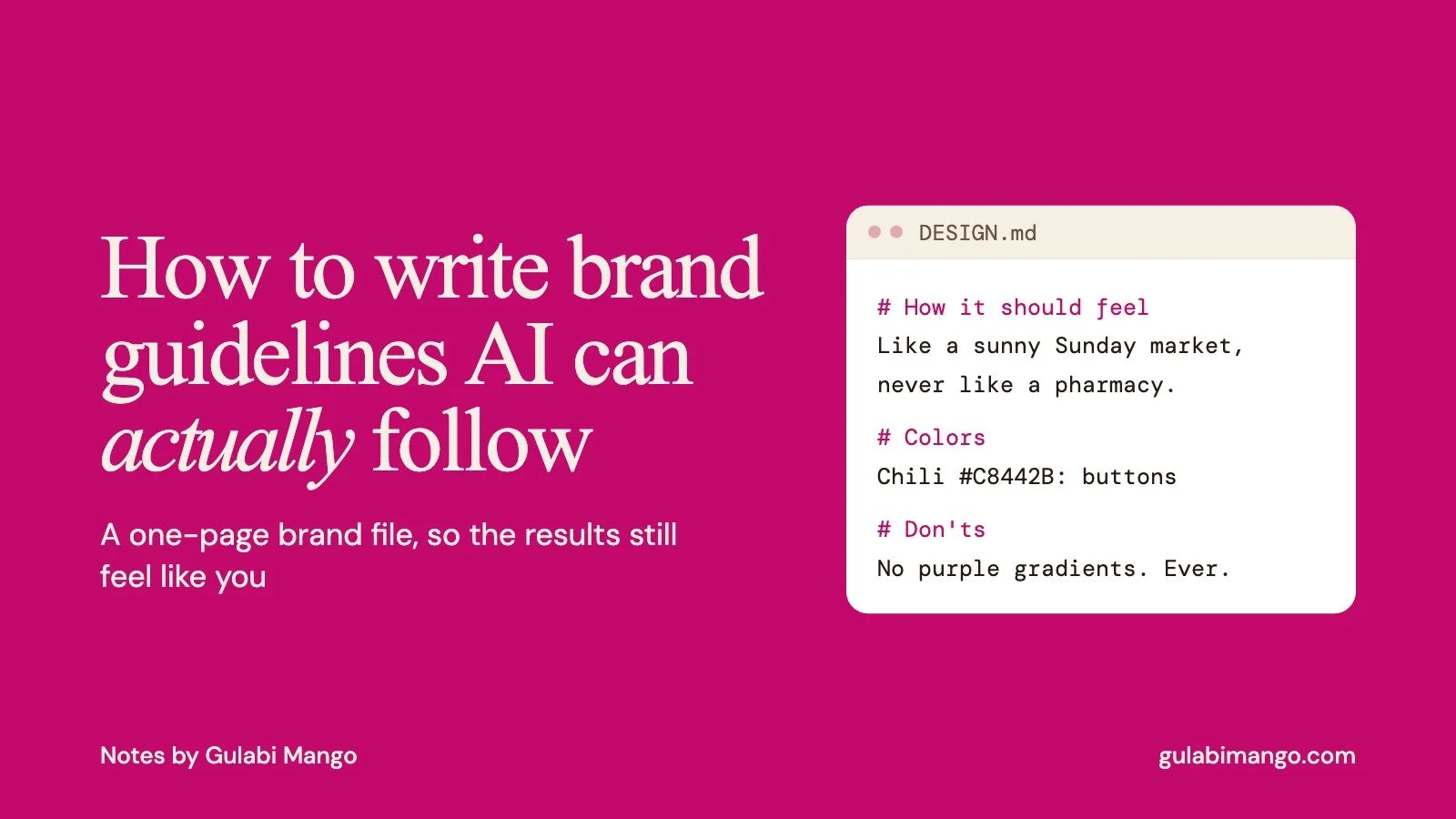
This year, a lot of the founders we work with started building their own landing pages, emails and social graphics with AI. Fast, cheap, and usually a little off. Same rounded buttons, same gradient, same "Welcome to the future of skincare." The tools are good. They just don't know you.
In April, Google Labs published DESIGN.md, a simple text file that describes a brand's visual rules so AI tools can follow them: colors, type, spacing, do's and don'ts. It came out of Stitch, Google's AI design tool, and coding tools like Claude Code, Cursor and GitHub Copilot can read it too.
We think every founder should have a version of this file. And we think the most important parts are the ones that aren't numbers.
1. What a brand file for AI looks like
It's a plain text document, one or two pages long. Google's spec suggests sections for:
Visual theme and atmosphere
Color palette and roles
Typography
Components (buttons, cards, forms)
Layout
Do's and don'ts
A prompt guide for the AI
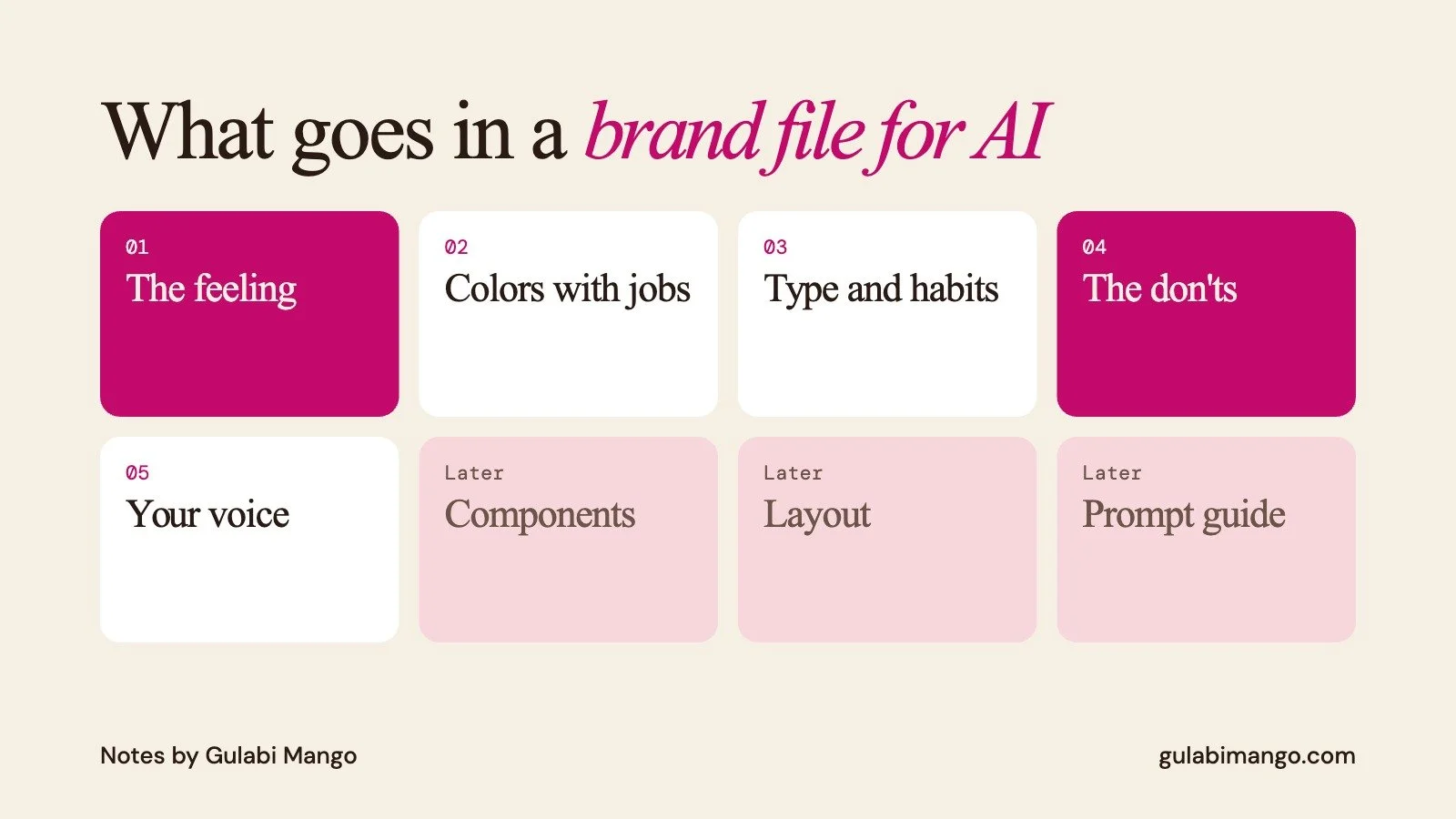
You don't need all of them on day one. Start with the five below, and add the rest as you use it.
2. Start with the feeling, then the rules
Before any hex codes, write three sentences on how your brand should feel. Use real references people can picture. "Like a sunny Sunday market, never like a pharmacy."
AI copies whatever it's given, so give it something worth copying.
[D: add a real example here. One anonymous AI result you fixed for a client: what the tool made, what felt off, and the line you added to their brand file that fixed it.]
3. Colors with jobs
List every color with its hex code and its role: background, headline, button, accent. Then say what never happens, like "no magenta on body text."
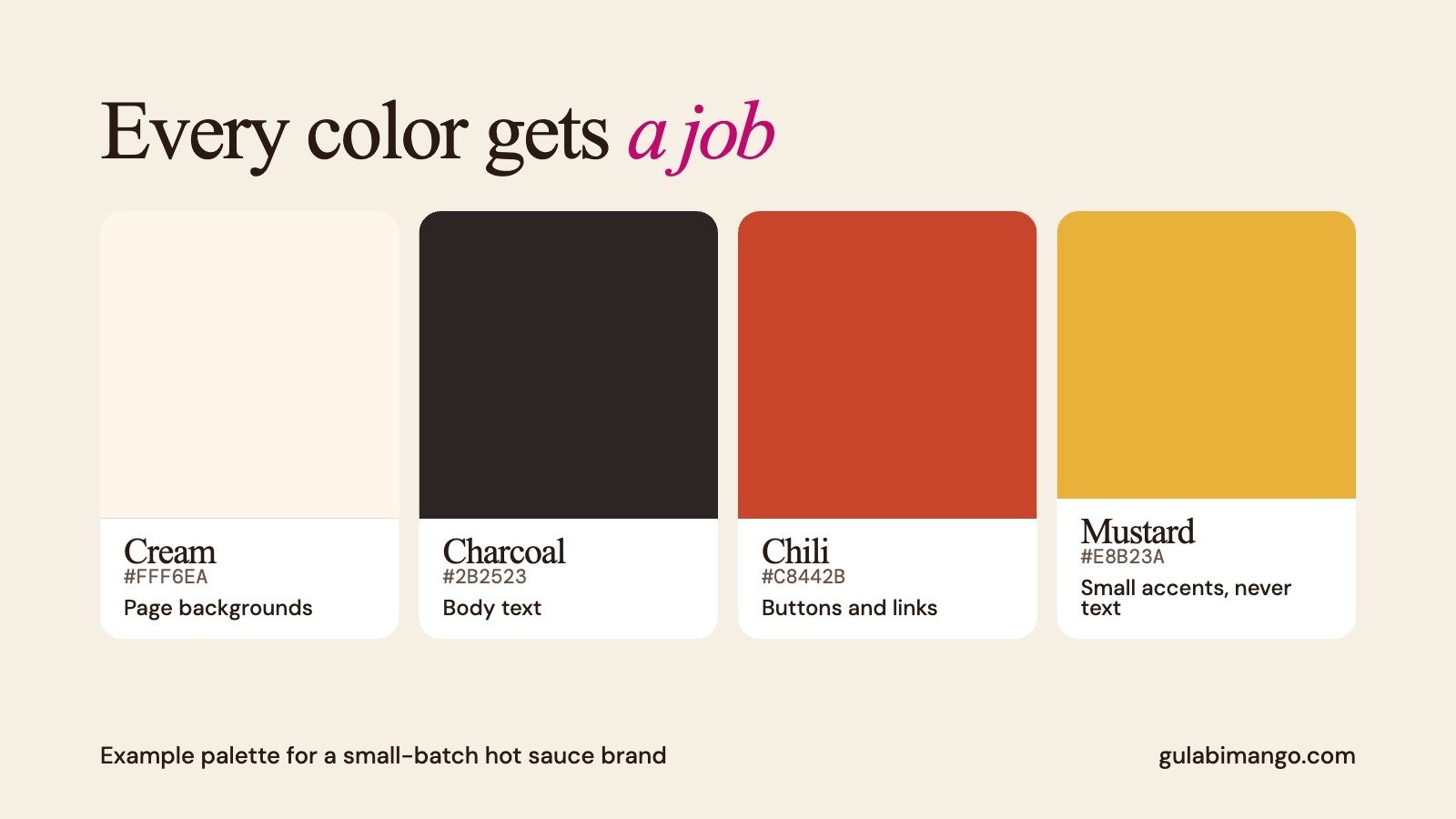
Here's what that could look like for a small-batch hot sauce brand:
Cream #FFF6EA: page backgrounds
Charcoal #2B2523: body text
Chili #C8442B: buttons and links
Mustard #E8B23A: small accents only, never text
4. Type with personality notes
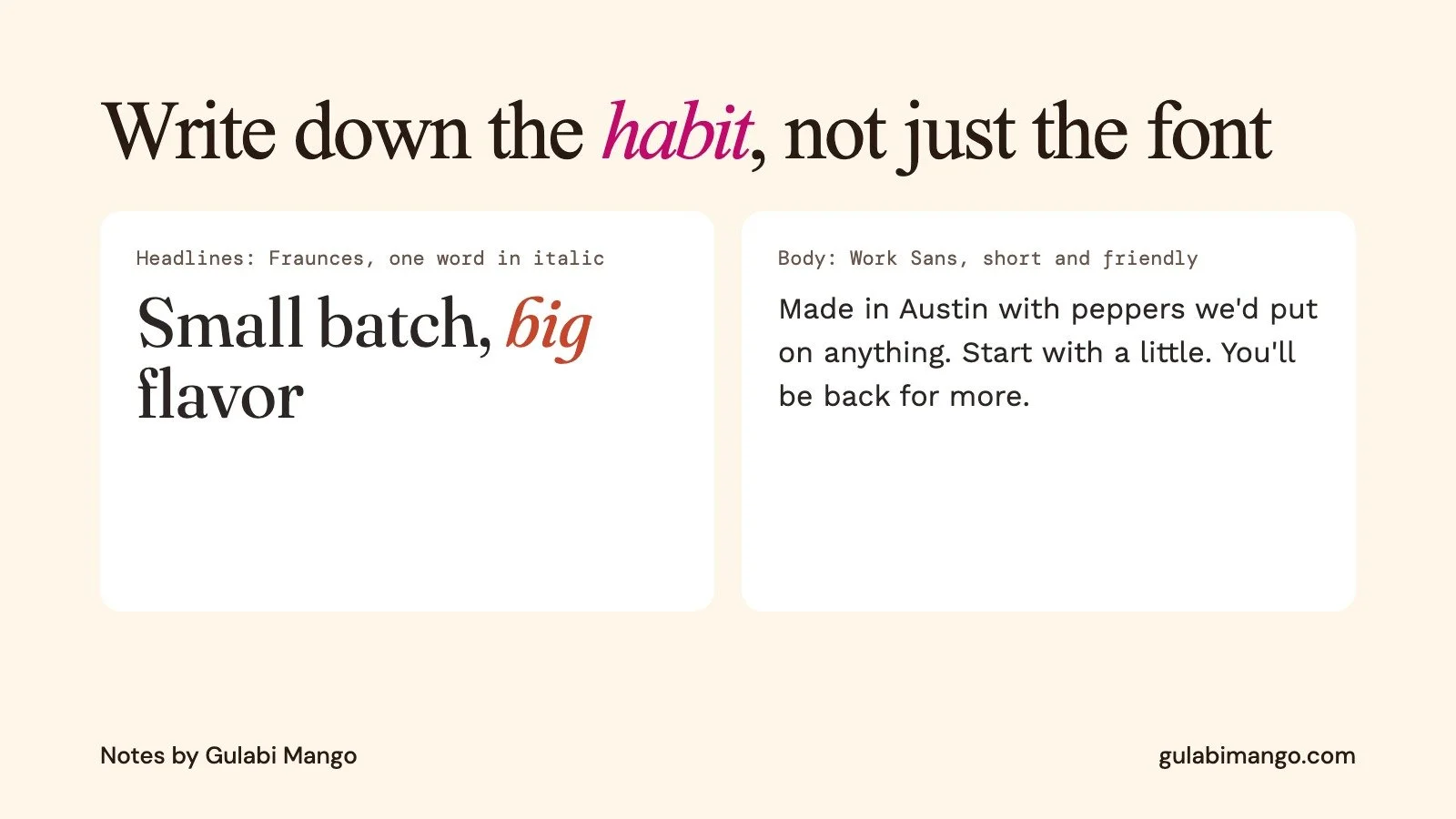
Name your fonts and how to use them. For our hot sauce brand, that might be: Fraunces for headlines, with one key word in italic, and Work Sans for body text.
That italic word is where the personality lives, so the rule goes in writing. If you only write "Fraunces, 64px," a tool will set every headline the same and the feeling goes flat. Write down the habit, not just the font.
5. The don'ts are where taste lives
This is the section most files skip, and it's the one that matters most. A generic tool will always reach for the same things. Ban them by name:
Stock photos of people pointing at laptops
Soft purple-to-blue gradients
Lines like "your daily ritual, reimagined"
Rounded everything, with no sharp edges anywhere
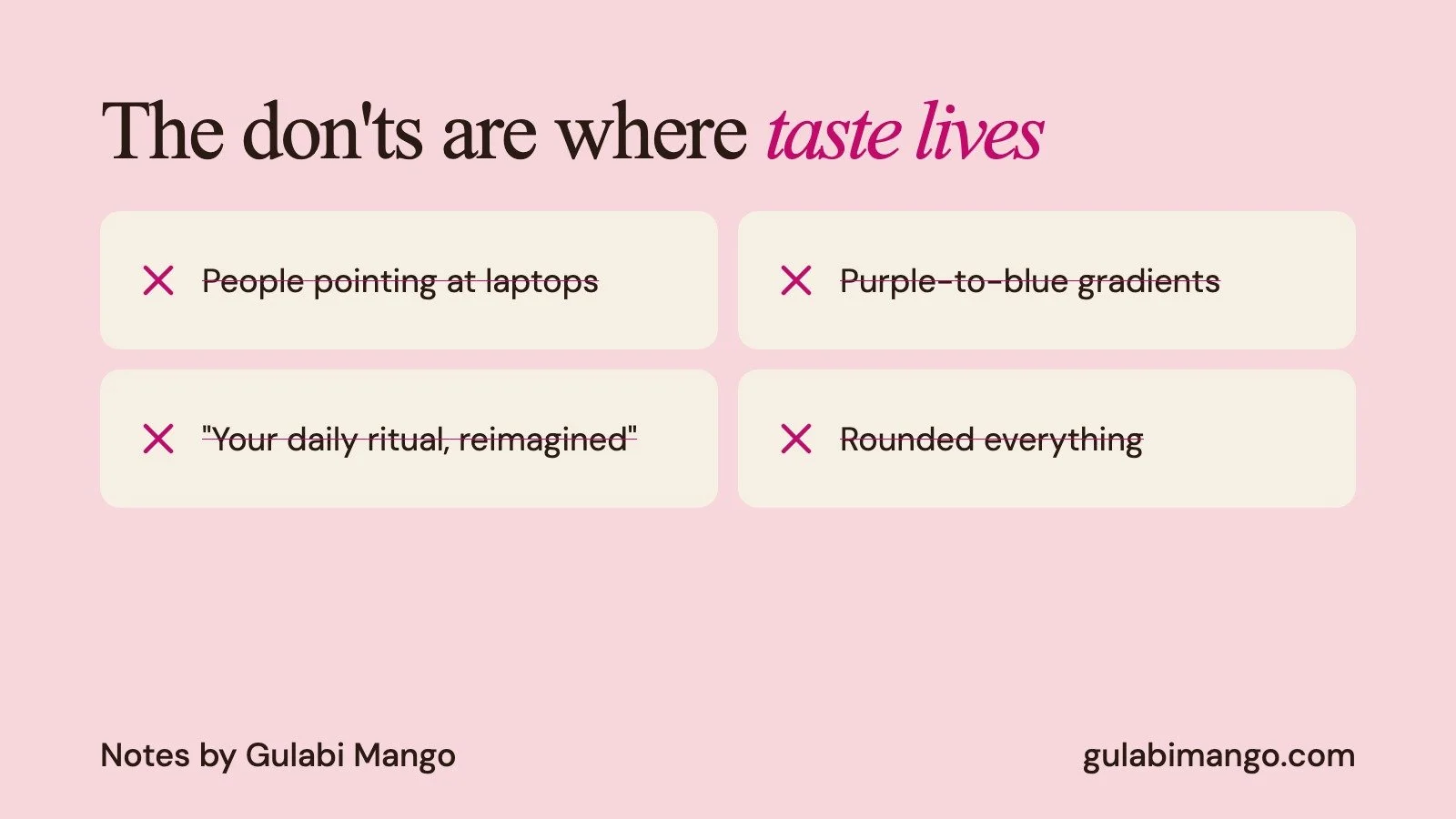
Your list will be different. The point is to write down what makes you wince, so the tool doesn't have to guess.
6. Your voice in five lines
Words matter as much as colors. Keep it short:
Two or three phrases you actually say
Two or three you'd never say
One real caption that sounds exactly like you
For the hot sauce brand, a sample caption might be: "New batch just dropped. It's hot. Like, actually hot. Pour responsibly 🌶️"
7. What a file can't do
A brand file keeps things consistent. It can't decide what your brand believes, which direction to kill, or when to break the rules on purpose.
That's still the job of a person with opinions and too many tabs open.
Your one-page brand file (copy it)
Paste this into a plain text file, name it DESIGN.md, and fill it in this week. Then hand it to whatever AI tool you use before you ask it for anything.
# [Brand name]
## How it should feel
[Three sentences. Use real references: "like ___, never like ___."]
## Colors
- [Name] #[hex]: [job, e.g. background]
- [Name] #[hex]: [job, e.g. headlines]
- [Name] #[hex]: [job, e.g. buttons]
- Never: [e.g. bright color on body text]
## Type
- Headlines: [font], [how you use it]
- Body: [font], [size and feel]
## Don'ts
- [Thing a generic tool always does that isn't you]
- [Another one]
- [Another one]
## Voice
- We say: [phrase], [phrase]
- We never say: [phrase], [phrase]
- Sample caption: [a real one]
The tools are fast. Taste is what makes it yours.
If you want help writing your brand file, or want a brand worth writing down in the first place, we'd love to hear about it. Get in touch or see our work.
Sources
Google Stitch open-sources DESIGN.md, April 2026
Google DESIGN.md: standard for AI-native design systems, April 24, 2026
